Working in UKHSA’s Experience Strategy team to make sense of Living with Covid services within a fragmented service landscape, prototyping a service taxonomy that connects missions, threats, user needs, services and products in one place.
Client
UK Health Security Agency
Sector
Healthcare
Role
Senior Service Designer
Outcome
Service taxonomy & retirement decisions
The project
One shared model for a complex service landscape
The UK Health Security Agency (UKHSA) prevents, prepares for and responds to infectious diseases and environmental hazards. As the pandemic response wound down, the organisation needed to make sense of its Living with Covid services and plan for what came next.
We created informed artefacts to reduce complexity, clarify ownership, and make service planning and organisational decisions easier in retiring Living with Covid services, and a service taxonomy that brought together UKHSA’s missions, threats, user needs, services, and products in one place. The model focused on people rather than organisational structures and supported the operating model and design strategy.
The challenge
Fragmented models, tight timelines, high scrutiny
The core challenge was making sense of Living with Covid services within an already fragmented service taxonomy, so teams could distinguish what needed active evolution from what should remain as pandemic legacy.
Strong legacy mental models from the pandemic response made boundaries and ownership hard to define.
The merger of DHSC and PHE added complexity, making it harder to surface and align information across teams.
Multiple missions, geographies, and service lifecycles increased the risk of inconsistency or oversimplification.
Services were described differently across programmes, teams, and historical contexts, with multiple overlapping and sometimes conflicting models in circulation and no shared agreement on which to use.
Timelines were tight, driven by clear ministerial needs, and Covid-related services were under high scrutiny both internally and in the public domain.
What we did
Synthesis, strategy, and co-design
I worked as a Senior Service Designer in the Experience Strategy team, taking a discovery-led, iterative approach to create a single, usable model for describing services, products, and missions across the organisation. I created high-level journeys to support policy makers in decision making about retiring Living with Covid services.
Mapped and compared the different models in use, assessing how well they worked against needs, service outcomes, and organisational priorities, narrowing down to four viable models tested through conversations and workshops.
Iteratively refined the models into a single, coherent, customer-oriented framework, then applied it to Living with Covid services to clarify boundaries, ownership, and relationships across the wider service landscape.
Created a shared service framework with clear definitions, boundaries, and ownership for each service, mapped against user needs, policy priorities, and organisational goals.
Developed guidance and visual tools to make the framework easy to use and reference.
Shared emerging thinking through show-and-tells, one-to-one sessions and regular feedback loops, giving stakeholders the chance to shape the direction.
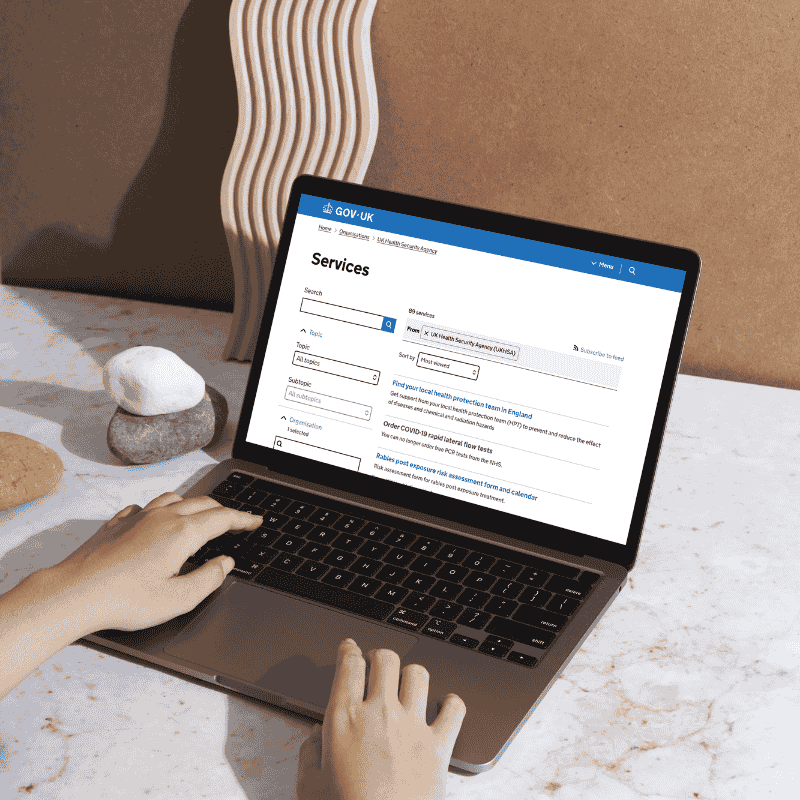
The UKHSA services catalogue on GOV.UK, part of the service landscape mapping that made the full portfolio visible to senior leaders.
The outcome
A practical, strategic decision-making tool
The project delivered not just a taxonomy, but a practical, strategic tool to strengthen organisational decision-making, improve communication across diverse teams, and provide a foundation for future service development and planning.
A tested prototype for the service taxonomy linking UKHSA missions, threats, user needs, services, and products.
Visual tools and journey frameworks to facilitate decision-making for organisational design and service planning, the basis of a renewed approach to the service catalogue, focusing more on non-Covid work.
Improved clarity on UKHSA services and reduced ambiguity and duplication across teams.
Influenced policy makers’ decisions in relation to retiring the Living with Covid services.
Brought a more customer-focused perspective to a very traditionally oriented organisation.
“I worked with Aimee at UKHSA on design strategy; she was fantastic. She had a wealth of previous experience to draw on. I found that Aimee's knowledge, her thoughtful advice, and her approach made her an absolute pleasure to work with.”
Tom Morgan, Lead Designer
Learnings
Reflections from this work
Designing in complexity. Complex systems don’t behave the way you expect if you only look at individual parts. What matters most are the relationships between things, change can’t be fully designed upfront, it has to be noticed, learned from, and adjusted as it unfolds.
Coherence is more than structure. Aligning models around user needs showed the importance of designing for people, not just organisational logic. Service visibility strengthens decision-making, governance, and delivery for every department.
Change takes time. The scale of change, combined with fatigue and uncertainty, meant progress was often slower than planned. Meaningful change depends on creating clarity and giving diverse groups of people time to breathe and adapt, especially in high-pressure environments.